
Clinical note templates tell CoTreat how to write your notes after each appointment, in the layout and wording you already use, ready to copy into your practice management system.
You don't need to write the template from scratch. Paste in one you already use, copy one of our examples below, or just describe what you want, and CoTreat builds it for you.
Other template guides:
In this article:
- Creating Your Template
- Using One of Our Example Templates
- Example Clinical Note Templates
- Getting Help
Creating Your Template
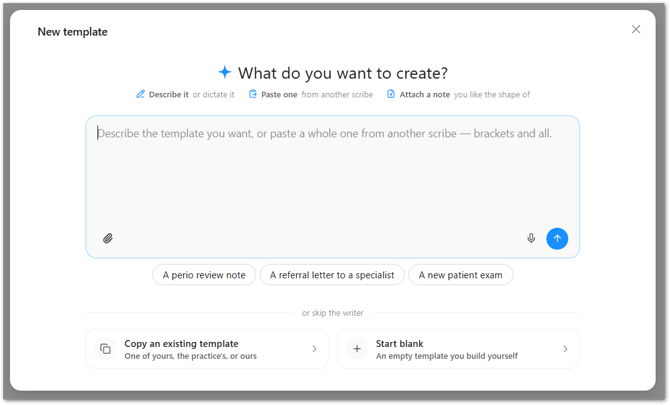
- Go to Create and click Create new template.
- In the What do you want to create? box, do one of the following:
- Paste a template you already use, including from another scribe. Paste the whole thing, brackets and all.
- Paste one of our examples from the bottom of this article.
- Describe it in your own words, or click the microphone to dictate it, e.g. "A perio review note with headings for history, findings, diagnosis and plan."
- Attach a note you like the shape of, using the paperclip icon.
- Click the arrow to send. CoTreat builds the template for you.
Make one template per appointment type, such as a comprehensive exam, a crown prep or a perio assessment.
Using One of Our Example Templates
- Go to Create and click Create new template.
- Click Start blank.
- In Tell CoTreat how it should read, paste this line:
You write a clinical note from an appointment transcript, using the layout below. The note is pasted directly into the practice system so it must be exactly what the dentist said. Short, plain and in this exact layout.
- Copy one of the example templates below and paste it into the first blue box.
- Give your template a name, e.g. Comprehensive Exam.
- At the bottom left, turn on Share with practice if you want your team to use it too.
- Click Add template.
Test your template on a recent appointment and compare the note with how you'd normally write it. If something's not quite right, change one thing at a time so you can see what made the difference.
Example Clinical Note Templates
Copy the whole template for the appointment type you need. Each one is complete on its own.
- Comprehensive Exam
- Aesthetics / Smile Consult
- Implant Assessment
- Root Canal Assessment
- Periodontal Assessment
- Crown Preparation
Comprehensive Exam
For comprehensive exams, including medical and dental history, charting, diagnoses and the treatment plan.
General Instructions:
(Use only the transcript, contextual notes or clinical note. Never come up with your own patient details, findings, diagnoses, plan or next steps.)
(Only include a line if it was mentioned. If nothing under a heading was mentioned, leave out the heading too. Never state that something wasn't mentioned.)
(Write None or NAD only if the dentist says so.)
(Clinical information is often said casually, out of order or while talking to the patient. It still counts.)
(If the dentist corrects themselves, use only the corrected value. If something is unclear or contradictory, write what was heard followed by [unclear: say what is unclear].)
(Use FDI notation for all teeth. Do not use any other notation such as UR1. If another notation is said, convert it only when the quadrant and tooth are both clear; otherwise write it as said followed by [unclear: tooth number].)
(Use phrasing such as "patient opted" rather than "dentist recommended".)
(Measurements in mm. Australian spelling.)
(Bold every heading and sub-label, exactly as shown. Bold the label only, never the content.)
(Put each heading on its own line, with the content on the next line. Leave a blank line before and after every numbered list.)
(Output the note only. Never copy anything in round or square brackets into the note.)

**Medical History:**
[confirmation that medical history was checked and updated]

**Presenting:**
[patient full name] arrived for [appointment type]
[who is attending with the patient, and their relationship or profession]

**WKY:**
[hobbies, occupation, work, interests, family, country of origin, and family members present at the appointment]

**Relevant Medical History:**
[relevant systemic medical history]

**Main Concern:**
[main reason for visit]

**Dental and Social History:**
**Brushing:**
[brushing frequency, toothpaste used, toothbrush type]
**Interdental Cleaning:**
[interdental cleaning method]
**Diet:**
[frequency and type of snacking, soft drinks, energy drinks, coffee and tea]
**Water:**
[water consumption rated as poor, fair, good or excellent]
**Sleep Quality:**
[sleep quality, average hours, jaw tenderness on waking]
**Last Dental Visit:**
[date and type of last dental visit]
**Trauma History:**
[any dental or maxillofacial trauma]
**Smoking Status:**
[smoking status and amount]

**Extra-Oral Examination:**
[extraoral findings]

**Intra-Oral Examination:**
**Soft Tissue:**
[findings on tongue, cheeks, palate and other oral soft tissues]
**Oral Cancer Screening:**
[suspicious lesions]

**Dentition and Caries Charting:**
[each tooth with a finding on its own line, by tooth and surface: missing teeth, caries, restorations, lesions, structural, endodontic, periodontal or functional status, mobility. If the dentist says the remaining teeth are intact, add one line saying so.]

**PSR:**
[periodontal screening result in the format XXX, XXX]
**Plaque:**
[+, ++ or +++]
**Calculus:**
[+, ++ or +++]
**NCTL:**
[grade (mild, moderate or severe) and type (attrition, abrasion, erosion or abfraction)]

**Occlusion:**
[type of occlusion]
**Overbite:**
[percentage]
**Overjet:**
[mm]
**Crowding:**
[mild, moderate or severe]

**Other:**
[other intraoral findings not covered above]

**Imaging:**
[intraoral photos, scans or other imaging taken]

**Radiographic Findings:**
[type of radiographs taken]
[radiographic findings by tooth or area]

**Problem List / Diagnoses:**

1. [each problem or diagnosis, one per line]

**Discussion and Treatment Options:**

1. [discussion of each problem with the patient, in the same order as the Problem List, including the options discussed]

[what the patient opted for, or that they will think about it] (Always include once treatment options are discussed.)

**Treatment Plan:**

1. [treatment in order, including today's appointment and follow-ups, one step per line, with time intervals]

**Post-Operative Instructions:**
**NV:**
[next visit type, duration and reason]
**RTR:**
[reason for return, in simple, patient-friendly language]
[patient first name and patient's condition on discharge]
- [name of clinician]

**Additional Information:**
- [any other relevant information not covered above, as bullet points]
Aesthetics / Smile Consult
For cosmetic and smile consultations, including smile analysis, options discussed and the patient's decision.
- Consent given for use of AI scribe to assist with speed, convenience and completeness of dental notes. (Only include if the patient's consent to the AI scribe is mentioned.)

Chief Complaint:
- [chief complaint and what the patient wants to change, in the patient's own words wherever possible]

Medical History:
- [confirmation that medical history was checked, and any changes]

Past Dental History:
- [previous dental treatment, surgeries, significant dental disease or injuries, and their outcomes]

Extra Oral Examination:
- [extraoral findings such as facial symmetry, lips, and TMJ examination including mouth opening]
- [any other extraoral findings]

Intra Oral Examination:
- Soft tissue examination: [buccal mucosa, tongue, palate, floor of the mouth, vestibule]
- Gingival examination: [colour, contour, size, consistency, surface texture, position, asymmetry, tooth coverage, visibility in smile, bleeding]
- Hard tissue examination: [findings by tooth and surface: teeth present and missing, caries, cracks in teeth or restorations, restored teeth, aesthetic blemishes, periapical problems, pathologic migration, overhanging restorations, impacted or supernumerary teeth, mobility]
- Tooth wear: [attrition, abrasion, erosion or abfraction, with grade]
- Shade & stains: [shade, stains and deposits]
- Prostheses: [lost or detached crown, veneer, inlay, onlay, or other prosthesis or appliance]
- Oral hygiene status: [oral hygiene status]
- Occlusion analysis: [classification, overbite, overjet, crossbite, open contacts, crowding, facets, supra contacts, trauma from occlusion, fremitus]
- Other: [any other intraoral findings]

Smile Analysis:
- [smile line and gingival display]
- [dental midline in relation to the facial midline]
- [tooth proportions, shape, symmetry and incisal edges]
- [buccal corridors]
- [any other smile findings]

Imaging & Radiographic Findings:
- [photos, scans or other imaging taken]
- [radiographs taken, and findings by tooth or area, including caries, cysts or tumours, tooth positions, bone levels, and comparison with previous radiographs]

Diagnoses:
- [each diagnosis, one per line]

Treatment Options:
1. [each option discussed, one per line, with the risks, benefits, costs, longevity and maintenance discussed]

Patient Decision:
- [what the patient opted for, or that they will think about it] (Always include once treatment options are discussed.)

Treatment Plan:
1. [planned treatment in order, by tooth, one step per line, with time intervals]

Next Steps:
- [specialist referred to and why]
- [next visit type and reason]

Additional Information:
- [any other relevant information not covered above]

(For each section, only include it if it was mentioned in the transcript, contextual notes or clinical note; otherwise leave out the line or the whole section. Never state that something wasn't mentioned.)
(Never come up with your own patient details, findings, diagnoses, options, costs, plan or next steps. Use only the transcript, contextual notes or clinical note.)
(Clinical information is often said casually, out of order or while talking to the patient. It still counts.)
(If the dentist corrects themselves, use only the corrected value. If something is unclear or contradictory, write what was heard followed by [unclear: say what is unclear].)
(Use FDI notation, with a space before surfaces. Convert from another numbering system only when the quadrant and tooth are both clearly said; otherwise write it as said followed by [unclear: tooth number].)
(Use phrasing such as "patient opted" rather than "dentist recommended". Measurements in mm. Australian spelling.)
(Use as many bullet points as needed to capture everything relevant. Leave a blank line between sections.)
(Output the note only. Never copy anything in round brackets or square brackets into the note.)
Implant Assessment
For implant consultations, including site evaluation, risk assessment and the surgical and prosthetic plan.
General Instructions:
(Use only the transcript, contextual notes or clinical note. Never come up with your own patient details, findings, measurements, risk categories, diagnoses, plan or prognosis.)
(Only include a line if it was mentioned. If nothing under a heading was mentioned, leave out the heading too. Never write "not mentioned" or "N/A" for something that wasn't discussed.)
(Write None, NAD or normal only if the clinician says so.)
(Clinical information is often said casually, out of order or while talking to the patient. It still counts.)
(If the clinician corrects themselves, use only the corrected value. If something is unclear or contradictory, write what was heard followed by [unclear: say what is unclear].)
(Use FDI notation for all teeth. If another notation is said, convert it only when the quadrant and tooth are both clear; otherwise write it as said followed by [unclear: tooth number].)
(Measurements in mm. Australian spelling.)
(Bold every heading and label, exactly as shown. Bold the label only, never the content. Never copy the words in square or round brackets into the note.)
(Several items go on separate lines under the label, starting with "- ". Treatment options are numbered. Leave a blank line before and after every list.)
(Output the note only.)

**Patient Information**
**Patient:** [name, age and gender]

**Chief Complaint**
**C/O:** [main reason for seeking implant treatment, with relevant details and duration]

**Medical History**
**Conditions:** [medical conditions, including any that may affect implant treatment]
**Surgeries & hospitalisations:** [previous surgeries and hospitalisations]
**Medications:** [current medications]
**Allergies:** [allergies, or NKDA if the patient confirms none]

**Dental History**
**Previous treatment:** [previous dental treatment and surgeries, with dates and outcomes]
**Periodontal history:** [history of periodontal disease and treatment]
**Trauma:** [dental trauma or other significant dental issues]

**Social History**
**Smoking & alcohol:** [smoking and alcohol, with amount and duration]
**Oral hygiene:** [brushing and interdental cleaning habits]

**Extra Oral Examination**
**Facial symmetry:** [any asymmetry or abnormality]
**TMJ:** [function, pain, clicking and range of motion]
**Lymph nodes:** [any palpable nodes and their characteristics]

**Intra Oral Examination**
**Mucosa:** [buccal mucosa, tongue, palate, floor of the mouth and vestibule]
**Gingiva:** [colour, contour, size, consistency, inflammation and bleeding]
**Teeth:** [teeth present and missing, and condition of the remaining teeth, by tooth]
**Occlusion:** [occlusion type, overbite, overjet, crossbite, parafunction and other occlusal findings]

**Implant Site Evaluation**
**Implant site:** [tooth number of the proposed implant site]
**Clinical bone assessment:** [ridge width, height and bone quality at the site]
**Radiographic bone assessment:** [bone density, height, and proximity to the nerve or sinus]
**Keratinised tissue:** [width and quality at the site]
**Soft tissue biotype:** [thin or thick, and any implications the clinician mentioned]

**Periodontal Examination**
**Pocket depths:** [pocket depths around existing teeth and potential implant sites]
**Attachment loss:** [areas and severity]
**Furcation:** [furcation involvement]
**Recession:** [recession at potential implant sites]
**Plaque index:** [plaque index scores]

**Radiographic Examination**
**OPG:** [findings relevant to implant placement, including bone, adjacent teeth and anatomical landmarks]
**CBCT:** [bone volume, density and proximity to vital structures at the proposed site]

**Diagnostic Casts & Scans**
[diagnostic casts or digital impressions taken, and findings on occlusion, arch form and anatomy]

**Laboratory Investigations**
[laboratory tests and their results]

**Risk Assessment**
(For each line, write the risk category only if the clinician states it, followed by the finding as said. Never work out a category from a measurement or finding.)
**Midfacial bone crest to gingival margin:** [risk category and finding]
**Facial plate integrity:** [risk category and finding]
**Facial plate thickness:** [risk category and finding]
**Horizontal defect dimension:** [risk category and finding]
**Gingival phenotype:** [risk category and finding]
**Primary stability:** [risk category and finding]
**Benign pathology:** [risk category and finding]
**Placement timing:** [risk category and finding]
**Patient compliance:** [risk category and finding]

**Diagnosis**
[each dental or periodontal diagnosis the clinician stated relevant to implant treatment, one per line]

**Treatment Plan**
**Treatment options:**

1. [each option discussed, with the benefits and risks discussed]

**Patient decision:** [what the patient opted for, or that they will think about it]
**Surgical plan:** [surgical approach, implant system, size, placement technique, and any grafting or sinus lift]
**Prosthetic plan:** [type of restoration, materials, provisional prosthesis and timeline]
**Postoperative care:** [medications, oral hygiene advice and follow-up visits]

**Prognosis**
[overall prognosis for implant success as stated by the clinician, and the factors they gave]

**Review & Follow-up**
[review dates and follow-up plans, including timelines for the healing and prosthetic phases]
Root Canal Assessment
For root canal appointments, including the pre-operative assessment, procedure, obturation and post-op advice.
General Instructions:
(Use only the transcript, contextual notes or clinical note. Never come up with your own patient details, findings, measurements, materials, doses or next steps.)
(Only include a line if it was mentioned. If nothing under a heading was mentioned, leave out the heading too. Never write "not mentioned" or "N/A" for something that wasn't discussed.)
(Record a procedure step, risk or instruction only if it was said or confirmed as done. Never assume a standard step happened.)
(If the clinician corrects themselves, use only the corrected value. If something is unclear or contradictory, write what was heard followed by [unclear: say what is unclear].)
(Use FDI notation for teeth. Measurements in mm, LA in mL. Australian spelling.)
(Bold every heading and label, exactly as shown. Bold the label only, never the content. Never copy the words in square or round brackets into the note.)
(Leave a blank line before and after every list.)
(Output the note only.)

**Patient Information:** [patient's name, age and gender]

**Tooth:** [tooth number]

**Medical History:** [whether medical history was reviewed, and any changes]

**Consent:** [verbal or written consent, and what it was for]

**Benefits of Root Canal Treatment:** [benefits of root canal treatment discussed]

**Discussed Relevant Risks:** [risks discussed]

**Pre-Operative Assessment:**
**Chief Complaint:** [primary reason for the visit]
**Clinical Examination:** [clinical examination findings, including any tests and results]
**Radiographic Examination:** [findings from radiographs]
**Diagnosis:** [pulpal and periapical diagnosis]

**Root Canal Procedure:**

- [local anaesthetic used: agent, strength, adrenaline and volume]
- [isolation used]
- [access cavity preparation]
- [canals identified and negotiated]
- [working length: method used, and lengths for each canal]
- [cleaning and shaping: hand files or rotary system, and file sizes]
- [irrigants used]
- [intracanal medicament placed]

**Obturation:**

- [how the canals were dried and obturated, and the technique, gutta-percha and sealer used]
- [temporary or permanent restoration placed, and material]

**Post-Operative Instructions:**
**Post-Op Advice:** [advice given on post-operative pain and swelling, and instructions for the next few days]
**Post-Op Analgesics:** [analgesics advised, with dose and frequency]
**Patient Questions:** [questions the patient asked and how they were answered]

**Next Visit:** [planned next visit, timing, and what will be done]
Periodontal Assessment
For periodontal assessments, including history, periodontal examination, diagnoses, prognosis and treatment.
General Instructions:
(Use only the transcript, contextual notes or clinical note. Never come up with your own patient details, findings, measurements, results, diagnoses, prognosis or treatment.)
(Only include a line if it was mentioned. If nothing under a heading was mentioned, leave out the heading too. Never write "not mentioned" or "N/A" for something that wasn't discussed.)
(Write normal, NAD or None only if the clinician says so.)
(Clinical information is often said casually, out of order or while talking to the patient. It still counts.)
(If the clinician corrects themselves, use only the corrected value. If something is unclear or contradictory, write what was heard followed by [unclear: say what is unclear].)
(Use FDI notation for teeth. If teeth are described another way, convert to FDI only when the quadrant and tooth are both clear; otherwise write it as said. Measurements in mm. Lab results with the units as said. Australian spelling.)
(Bold every heading and label, exactly as shown. Bold the label only, never the content. Never copy the words in square or round brackets into the note.)
(Leave a blank line before and after every list.)
(Output the note only.)

**Patient Information:**

- [patient's name, age and gender] (Full sentences.)

**Chief Complaints:**

- [each complaint with its duration, such as gum bleeding, swelling, pain, bad breath, loose teeth or cosmetic concerns] (One complaint per line.)

**History of Presenting Complaints:**

- [each complaint in turn: onset, progression, aggravating or relieving factors, associated symptoms, duration, intensity, nature and frequency] (Full sentences, one complaint per bullet.)
- [any cosmetic concerns] (Full sentences.)

**Past Dental History:**

- [previous dental treatment, periodontal treatment or surgery, and significant dental disease or injuries, with dates and outcomes] (One item per line.)

**Past Medical History:**

- [medical conditions, previous surgeries, hospitalisations, ongoing treatment, allergies and medications] (One item per line.)

**Personal History:**

- [oral hygiene practices: brushing frequency, interdental cleaning and mouthwash] (Full sentences.)
- [habits: clenching, grinding, biting, smoking, vaping, tobacco chewing and alcohol, with amount and duration] (Full sentences.)

**Family History:**

- [relevant family history, especially periodontal disease or systemic conditions] (Full sentences.)

**Extra Oral Examination:**

- [lymph nodes, facial symmetry, TMJ including mouth opening, and lips] (Full sentences.)
- [any other extraoral findings] (Full sentences.)

**Intra Oral Examination:**

- **Soft tissue examination:** [buccal mucosa, tongue, palate, floor of the mouth and vestibule] (Full sentences.)
- **Gingival examination:** [colour, contour, size, consistency, surface texture, position, bleeding and where, exudate, attached gingiva and gingival tension test] (Full sentences.)
- **Periodontal examination:** [BPE/PSR scores, pocket depths and sites, clinical attachment loss, furcation involvement, recession, mucogingival junction and plaque index] (Full sentences.)
- **Hard tissue examination:** [teeth present and missing, caries, restorations, periapical problems, pathologic migration, overhangs, impacted or supernumerary teeth, attrition, abrasion, erosion or abfraction, mobility grades, shade, stains and deposits, by tooth] (Full sentences.)
- **Oral hygiene status:** [good, fair or poor, and the index used] (Full sentences.)
- **Occlusion analysis:** [Angle's classification, overbite, overjet, crossbite, open contacts, crowding, facets, supra contacts, trauma from occlusion and fremitus] (Full sentences.)
- **Other:** [any other intraoral findings] (Full sentences.)

**Radiographic Findings:**

- [radiographs taken, and findings including bone loss pattern and amount, periodontal ligament, caries, cysts or tumours, tooth positions, and comparison with previous radiographs] (Full sentences.)

**Laboratory Investigations:**

- [each test with its result, such as blood count, haemoglobin, platelets, bleeding time, clotting time, ESR, blood glucose or HbA1c] (One test per line.)
- [biopsy findings] (Full sentences.)

**Diagnoses:**

- [each diagnosis exactly as the clinician stated it, including stage, grade and extent if stated] (One diagnosis per line. Never invent or infer a diagnosis.)

**Prognosis:**

- [overall prognosis and the reasons given] (Full sentences.)
- [prognosis for individual teeth at risk, by tooth] (Full sentences.)

**Treatment:**

- [each treatment planned or recommended] (One per line.)
- [each preventive measure, such as oral hygiene instructions or smoking cessation advice] (One per line.)
- [review date or follow-up plan] (Full sentences.)
Crown Preparation
For crown prep appointments, including pre-procedure tests, preparation, impressions, temporary crown and lab details.
General Instructions:
(Use only the transcript, contextual notes or clinical note. Never come up with your own findings, test results, doses, materials, shades or next steps, and never fill a line with a default or "normal" result.)
(Only include a line if it was mentioned. If nothing under a heading was mentioned, leave out the heading too. Never write "not mentioned" or "N/A" for something that wasn't discussed.)
(Record a test, step or material only if it was said or confirmed as done. Never assume a standard step happened.)
(Record a diagnosis only as the clinician stated it. Never interpret test results or radiographs into a diagnosis.)
(If the clinician corrects themselves, use only the corrected value. If something is unclear or contradictory, write what was heard followed by [unclear: say what is unclear].)
(Use FDI notation for teeth, written as the number only (e.g. 16, not #16). Measurements in mm, LA in mL. Australian spelling.)
(Bold every heading and label, exactly as shown. Bold the label only, never the content. Never copy the words in square or round brackets into the note.)
(Output the note only.)

**Chief Complaint:**
[chief complaint, with duration]

**History of Presenting Complaints:**
[detailed description of the complaints related to the tooth being crowned: onset, progression, pain type, triggers, what relieves it]

**Pre-Procedure Discussion:**
**Risk Discussion:** [each risk discussed with the patient]
**Consent:** [verbal or written, and what it was for]
**Cold Test:** [tooth and result as stated]
**Tender to Percussion (TTP):** [tooth and result as stated]
**Radiographic Findings:** [radiograph taken and findings as stated]
**Diagnosis:** [diagnosis for the tooth, as stated]

**Procedure:**
**Anaesthesia:** [agent, strength, adrenaline, volume, technique and site]
**Tooth Preparation:** Tooth [tooth number] prepared for crown. [any removal of old restoration, caries or core build-up, with material]
**Gingival Retraction:** [method, and cord size if stated]
**Impressions:** [impression method, scanner or material, and bite registration]
**Temporary Crown:** [temporary material, cement, and occlusion check]
**Laboratory Instructions:** Crown impression and details sent to [laboratory name].
**Shade Selection:** Shade [shade] chosen for the crown.
**Crown Type:** Crown type is [crown type].
**Item Numbers:** [ADA item numbers as said]

**Post-Operative Instructions:**
[instructions given, such as temporary crown care and when to contact the practice]

**Additional Diagnoses/Notes:**
**Other Teeth/Oral Health:** [other teeth, gums or general oral health issues discussed, and any treatment needed]

**Prognosis:**
[prognosis for the tooth and any other teeth, as stated]

**Review Date/Follow-Up:**
[date or timing of the next visit and its purpose]
Getting Help
If you're having any trouble setting up or adjusting a template, feel free to reach out:
- Click the Help icon in CoTreat and select Contact Support, or
- Email help@cotreat.com.au
We're happy to help tailor a template to the way you write your notes.