
Templates tell CoTreat how to write the documents it creates from an appointment, such as clinical notes, patient letters and case presentations. Set one up once and every document after that follows your format, tone and practice details.
This is the full guide. If you just want to get started quickly, use the guide for the document you're making:
- Clinical notes: Creating Your Clinical Note Template
- Patient letters: Creating Your Patient Letter Template
- Case presentations:Creating Your Case Presentation Template
In this article
- Creating a Template
- The Building Blocks
- Setting the Tone
- Adding Your Practice Details
- Writing Good Blue Boxes
- Using Widgets
- Including Patient Images
- Adding Videos, Links and Downloads
- Editing, Copying and Saving
- Common Questions
- Getting Help
Creating a Template
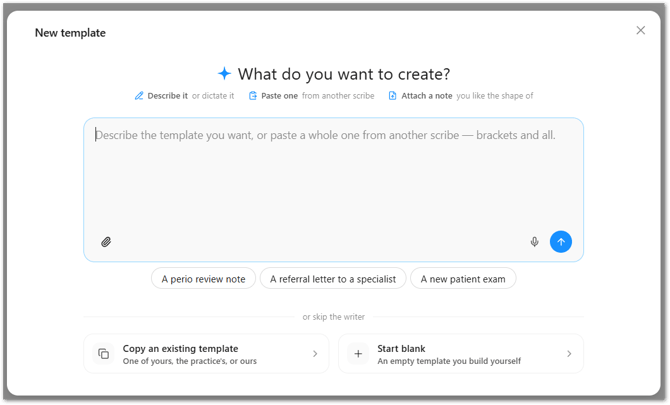
Click Create > New template, then choose one of three ways:
- Let CoTreat build it: in the What do you want to create? box, describe or dictate what you want, paste a template from another scribe (brackets and all), or click the paperclip to attach a document you like the shape of. Click the arrow and CoTreat builds the template.
- Copy an existing template: start from one of yours, your practice's, or CoTreat's. Select it and click Copy and edit. The original stays as it is. This is the best way to start a patient letter or case presentation.
- Start blank: an empty template you build yourself. This works well for clinical notes, where you paste in one full set of instructions.
The Building Blocks
You don't write the document itself. You write short instructions, and CoTreat uses them to write each document from the appointment.
- Tell CoTreat how it should read: the box at the top. Sets the tone and style for the whole document.
- Headings: section titles, the same for every patient.
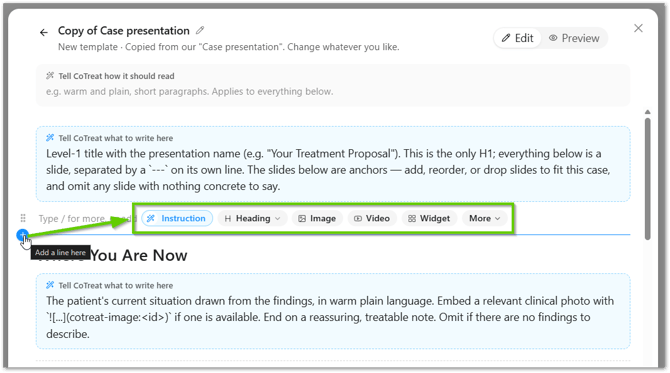
- Blue boxes: blue instruction boxes that tell CoTreat what to write in each section. You'll see them labelled Tell CoTreat what to write here, and you add them with Instruction.
- Image and Video: fixed content that appears in every document made from the template.
- Widgets: ready-made visual sections that CoTreat fills in for each patient: Roadmap, Treatment options, Investment and Payment plans.
- More: other formatting, such as quotes and bullet or numbered lists.
To add any of these, hover where you want it and click the + icon, or click Click to add a line at the bottom.
Setting the Tone
Use Tell CoTreat how it should read to make documents sound like your dentists, and to adapt each one to the patient. For example, gentler for a nervous patient or clearer on costs for someone worried about money. Here's a starting point you can paste in and adjust:
Write as the treating dentist speaking to the patient. Warm, calm and plain English, with short sentences and paragraphs. Use the dentist's own words from the appointment. Never salesy or pushy. Australian spelling.

Match how the patient came across in the appointment:
- Nervous, or mentioned a bad past experience: be extra gentle and reassuring, and explain what happens next step by step.
- Worried about cost: be clear and upfront about any fees discussed, and mention payment options if they came up. No pressure.
- Asked lots of detailed questions: give more detail and the reasons behind the recommendation.
- Short on time or wanted the bottom line: keep it brief and lead with the next step.
- Chatty and upbeat: be warm and encouraging, and focus on how they'll look and feel.
Base this only on what the patient said and how they responded. Never label the patient or mention their personality.
The patient styles are based on the DISC communication styles: direct, enthusiastic, steady and detail-focused. CoTreat picks up the cues from the appointment, so you don't need to tell it which style each patient is.
Clinical note templates usually don't need this box, as the template itself sets the format.
Adding Your Practice Details
To make sure your contact person, payment options or booking links are correct, add them in a blue box at the very top of the template. For example:
MY PRACTICE DETAILS
Change the words in [CAPITALS]. Delete any line you don't need. Any line still showing [CAPITALS] is ignored.

CONTACT PERSON: [NAME], [ROLE]
PHONE: [PHONE NUMBER]
BOOKING LINK: [PASTE LINK]
CLOSING: [Warm regards or Kind regards]

Only use details that are filled in above. Never make up names, numbers or links.
- Any line still showing [CAPITALS] is skipped, so documents never show placeholder details.
- Other blue boxes can then say "from My Practice Details" instead of repeating the name or number.
- Each template keeps its own details. If something changes, update it in each template you use.
The patient letter and case presentation guides each have a ready-to-paste version.
Writing Good Blue Boxes
Each blue box works best when it covers three things:
- What to write: e.g. "What the dentist found, in plain English."
- Where it comes from: e.g. "Use only what was said in the appointment."
- When to leave it out: e.g. "Leave this section out if everything was healthy."
For example:
This is the findings section.
- In plain English, what the dentist found and what it means for the patient.
- Use only what was said in the appointment.
- Leave out this section if everything was healthy.
If a section shouldn't appear for every patient, always say when to leave it out. Otherwise CoTreat may still show it.
Using Widgets
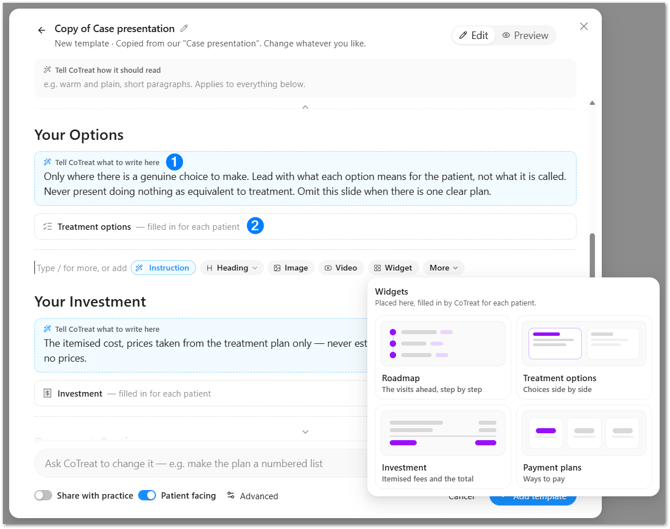
Widgets are designed for case presentations. Most letters and notes don't need them.
- Treatment options: choices side by side. Each has an option name, a one-line summary, a short detail and a price, and you can mark the recommended one.
- Roadmap: the visits or phases ahead, step by step, with when, how long and who's involved.
- Investment: itemised fees and the total, from the treatment plan.
- Payment plans: ways to pay, each with a title, headline and amounts.
Put each widget section in this order: heading, then blue box, then widget. The blue box tells CoTreat how to fill the widget.
Including Patient Images
CoTreat can automatically add the patient's own images from the session. Images from your practice system have a type (Bitewing, Intraoral, Arch or Generated) and a capture date. Generated images are created by CoTreat, such as smile previews.
To include them, say in a blue box which type to use and when. For example:
If the dentist mentioned a bitewing or X-ray, include the most recent Bitewing image.
If they mentioned an intraoral photo, include the most recent Intraoral image.
If none were mentioned, don't include an image here.
Adding Videos, Links and Downloads
- Videos: add a Video line and paste a direct YouTube link. Embed codes and uploads from your computer aren't supported, so upload to YouTube first (set to Unlisted to keep it out of search).
- Links: add the full link (starting https://) to your practice details blue box, and say when to include it. CoTreat turns links into clickable words.
- Downloads: files such as PDFs can't be uploaded. Upload to Google Drive, OneDrive or Dropbox, set sharing to anyone with the link, and add that link.
Editing, Copying and Saving
Saving
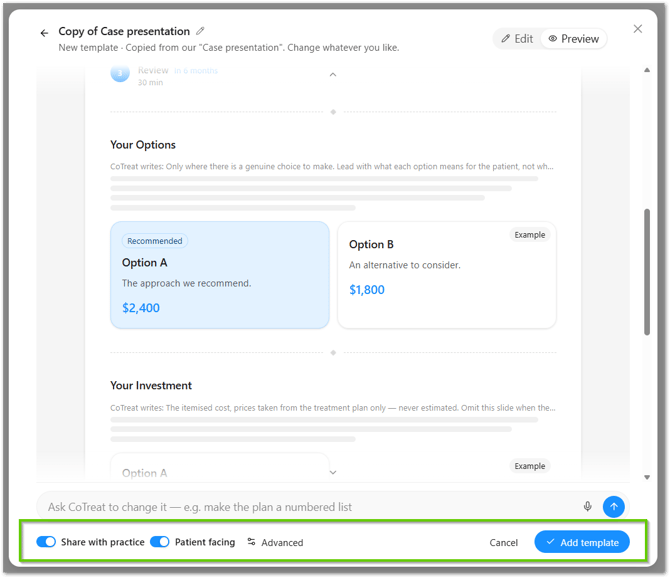
- Click Preview to check how it looks.
- Choose your settings:
- Share with practice: on means everyone at your practice can use it.
- Patient facing: turn on for letters and presentations so they can be added to a care pack.
- Click Add template, or Save if you're editing.
Editing or copying
- In the chat bar, click Create.
- Click the eye icon next to the template.
- Click Edit, make your changes and click Save. Or click Make my own copy to start a new template from it, and click Add template.
Removing parts
- Heading: click into it and press backspace.
- Blue box or widget: hover over it and click the bin icon on the right.
Common Questions
Which way of creating a template should I use?
For patient letters and case presentations, copy CoTreat's template and customise it. For clinical notes, start blank and paste in one of our examples, or paste in your own from another scribe.
Why isn't my template using the right contact details?
Add them to a blue box at the top of the template. See Adding Your Practice Details.
Can I upload a video or PDF from my computer?
Not directly. Use a direct YouTube link for videos, and a Google Drive, OneDrive or Dropbox share link for files.
Can I have more than one template of the same type?
Yes. For example, separate letters for check-ups and implant consults. Set one up fully, then use Make my own copy.
Can I use the same template as my colleagues?
Yes. Turn on Share with practice when saving, and it appears for everyone at your practice.
Getting Help
Stuck, or have feedback or a feature request? We'd love to hear how your templates are working and what you'd like to see next.
- Click the Help icon in CoTreat and select Contact Support, or
- Email help@cotreat.com.au